 |
Knitting Information | Knit Patterns
 Printer-friendly version
The knitting needle is used to reach through a stitch in order to pull a length of knitting yarn back through the stitch to form a new loop at the top of the current stitches. The simplest requirements of knitting needles are that they must be smooth, thin and long enough to reach through a stitch and strong enough not to break while manipulating the yarn.
Knitting is fun and is an amazing hobby that soothes you, fulfills a need to be creative and results in one-of-a-kind beautiful projects like sweaters, socks, pillows, dolls and teddy bears, to name a few.
Knitting Patterns Fast Facts
The art of hand knitting has been practiced for thousands of years. How this art was originally learned is a mystery but some believe that it originated in Persia. 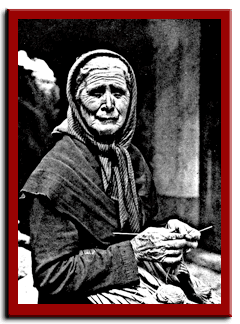 Others claim Israel, Jordan and Syria as its origin, and still others claim mountains of North Africa. In the medieval Europe hand knitting was an important industry and had developed into an advanced craft by 16th century.
The most widely recognized form of knitting needle, probably invented in the mid 19th Century, is usually called a straight needle. Straight needles are narrowed nearly to a point at one end and capped at the other with a knob or head (like the head of a straight pin), and are used almost exclusively for knitting flat two-dimensional fabrics like rectangles and squares. Some of the most common stitches known are: Knit, Purl, Garter, and Stocking (or Stockinette).
The oldest known knitting needles are double-pointed needles. They are generally used to form tubular fabrics such as socks and the bodies or sleeves of sweaters. Double-pointed needles are tapered at both ends nearly to points. They are normally used in sets of four or five as depicted in a number of 14th Century oil paintings.
Both tubular and flat knitting is also done on circular knitting needles, consisting of two pointed needles joined together by a flexible wire or length of nylon. Some manufacturers sell the two needles and the joining length of nylon separately.
According to a study done by Research Inc. for Craft Yarn Council of America, 34 million women in 1994 crocheted or knitted. In 2002, some 38 million women do.
Did You Know?
Knitted socks discovered in Egyptian tombs have been dated between the 3rd and 6th centuries AD.
Originally knitting remained entirely confined to making socks and women's stockings.
In 1589, a clergyman named William Lee invented the first knitting machine in England. The basic technology of modern day knitting machines is still similar to Lee's machine.
Between 1880 and 1910, knitwear was mainly a female fashion, but later knitted pullovers, cardigans, men's underwear, sportswear and swimwear became popular for men. Knitted garments have now become every day dress for men, women and children.
| Pattern Categories Browse the categories to help you find the patterns you're looking for. |
||
     
|

|

|
Navigation

All contents © 2003-2025 Purple Kitty LLC. All rights reserved.
Privacy Policy | FAQ | About Me | Newsletters | Sitemap